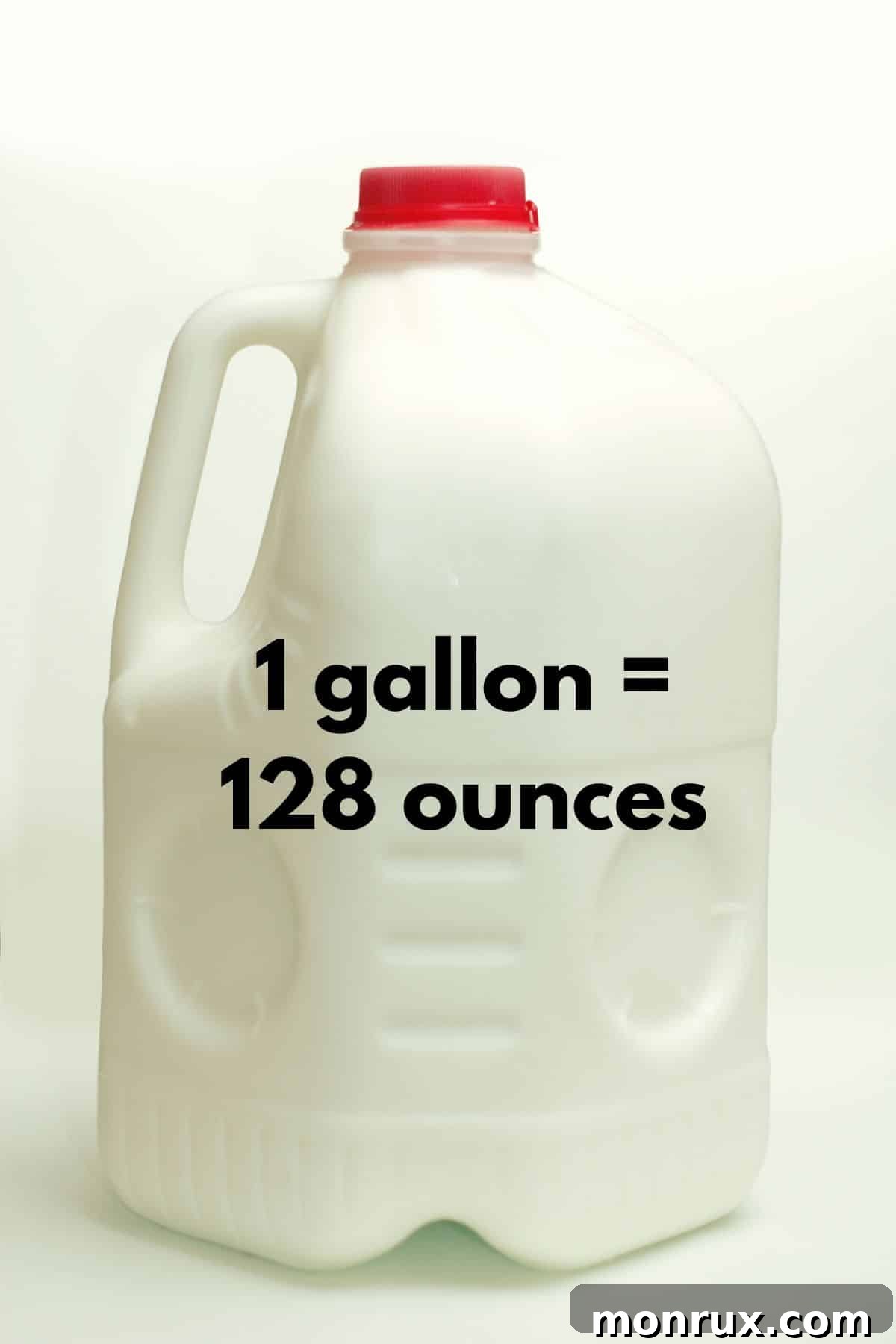
Understanding fundamental kitchen conversions and measurement systems is crucial for both novice and experienced cooks. One of the most common questions revolves around liquid volumes, specifically: How many ounces are in a gallon? The simple answer, essential for anyone navigating U.S. recipes and product labels, is that there are 128 fluid ounces in a U.S. liquid gallon. This comprehensive guide will delve deeper into liquid measurements, explore different types of gallons, clarify the distinction between fluid and dry ounces, and provide practical tips for accurate conversions in your culinary adventures.
Understanding Measurement Systems
The journey to understanding ounces and gallons begins with a brief look at the history of measurement systems. The modern world primarily operates under two main systems: the Imperial system and the Metric system. The Imperial system, which uses units like gallons, ounces, pounds, and miles, originated in the British Empire. Over centuries, as nations developed and trade expanded, this system was adopted and adapted by various countries, most notably the United States.
In the U.S., a derivative known as the U.S. customary system emerged. While sharing many unit names with the Imperial system, the actual values of some units can differ significantly. This distinction is particularly important when dealing with liquid volumes. It is within the U.S. customary system that we define the U.S. liquid gallon as precisely equivalent to 128 U.S. fluid ounces. This standard is vital for everything from purchasing beverages to following a recipe and understanding fuel efficiency in the United States.
Grasping this core relationship is the first step in confidently handling liquid measurements. Whether you’re filling a car’s gas tank, buying milk at the grocery store, or accurately portioning ingredients for a large batch recipe, knowing that 128 fluid ounces constitute a U.S. gallon provides a solid foundation for any volumetric calculations.
The Gallon Demystified: Different Types and Conversions
While the 128 fluid ounces per gallon rule is standard in the U.S., it’s crucial to recognize that “gallon” isn’t a universally identical unit. There are distinct types of gallons, and understanding their differences is key to avoiding confusion, especially when dealing with international recipes or products.
- U.S. Liquid Gallon: This is the most prevalent gallon in everyday use across the United States. It’s used for measuring liquids like water, milk, gasoline, and most beverages. A U.S. liquid gallon contains exactly 128 U.S. fluid ounces. This gallon can also be broken down further:
- 1 U.S. liquid gallon = 4 U.S. liquid quarts
- 1 U.S. liquid quart = 2 U.S. liquid pints
- 1 U.S. liquid pint = 2 U.S. cups
- 1 U.S. cup = 8 U.S. fluid ounces
- Therefore, 1 gallon = 4 quarts * 2 pints/quart * 2 cups/pint * 8 fluid ounces/cup = 128 fluid ounces.
To calculate the total fluid ounces for multiple gallons, simply multiply 128 by the number of gallons. For instance, two gallons contain 256 fluid ounces.
- U.S. Dry Gallon: Less commonly encountered in daily life, the U.S. dry gallon is used for measuring certain dry commodities, particularly in agricultural contexts for products like grains or produce. It is not equivalent to the U.S. liquid gallon and cannot be directly converted using fluid ounces. A U.S. dry gallon is approximately 4.405 liters, which is larger than a U.S. liquid gallon (3.785 liters). This distinction highlights why it’s critical to always specify “liquid” or “dry” when referring to U.S. gallons, though the liquid gallon is assumed unless otherwise stated.
- Imperial (UK) Gallon: Used in the United Kingdom and some Commonwealth countries, the Imperial gallon is larger than the U.S. liquid gallon. An Imperial gallon is equivalent to 160 Imperial fluid ounces. This difference is substantial:
- 1 Imperial gallon ≈ 4.546 liters
- 1 U.S. liquid gallon ≈ 3.785 liters
When following a recipe from the UK or buying products from countries that use the Imperial system, it’s essential to perform the correct conversion to U.S. customary units to ensure accurate measurements and successful results. Ignoring this difference can lead to significant discrepancies in ingredient ratios.
Understanding these variations prevents common errors in cooking, manufacturing, and international trade. Always double-check the origin of your measurements to determine which type of gallon and fluid ounce is being referenced.
Navigating the Metric System: Liters and Milliliters
While the U.S. customary system, with its gallons and ounces, is prevalent in the United States, most of the world operates under the metric system. The metric system is a decimal-based system, meaning its units are related by powers of 10, making conversions incredibly straightforward. In the metric system, volume is primarily measured in liters (L) and milliliters (mL), rather than gallons and fluid ounces.
The relationship is simple: 1 liter is equivalent to 1,000 milliliters. This base-10 structure simplifies calculations significantly compared to the often irregular conversion factors of the Imperial and U.S. customary systems.
Converting between the metric system and the U.S. customary system is a common necessity, especially in scientific research, international commerce, and when using global recipes. Here are some key conversion factors:
- 1 U.S. liquid gallon ≈ 3.785 liters
- 1 Imperial gallon ≈ 4.546 liters
- 1 U.S. fluid ounce ≈ 29.57 milliliters
- 1 Imperial fluid ounce ≈ 28.41 milliliters
These conversions are invaluable. For instance, if you encounter a recipe from a European country that calls for 2 liters of broth, knowing that 1 U.S. liquid gallon is approximately 3.785 liters means you’ll need roughly half a gallon. Similarly, if a product is labeled in milliliters, you can easily convert it to fluid ounces for a better sense of its volume in the U.S. context.
Some industries, such as automotive or engineering, might also measure volume in cubic inches or cubic centimeters (which are equivalent to milliliters). Understanding the interconnectedness of these measurement units, even if they seem disparate, can prove beneficial in various practical applications.
Ounces in the Kitchen: Volume vs. Weight
One of the most frequent sources of confusion in cooking, particularly with ounces, is the distinction between measuring by volume and measuring by weight. An “ounce” can refer to two entirely different properties: fluid ounces (a unit of volume) and avoirdupois ounces (a unit of weight). Understanding this critical difference is paramount for achieving accurate and consistent results in the kitchen.
Fluid Ounces (Volume)
Fluid ounces are used to measure the space a liquid occupies. This is typically what people mean when they ask “how many ounces in a gallon,” referring to liquid capacity. In the U.S. customary system:
- 1 U.S. fluid ounce = 1/128 of a U.S. liquid gallon
- 1 U.S. fluid ounce = 1/16 of a U.S. pint
- 1 U.S. fluid ounce = approximately 2 tablespoons
When a recipe specifies “ounces” for ingredients like water, milk, broth, olive oil, or juice, it almost always refers to fluid ounces. These are best measured using liquid measuring cups, which are typically transparent with a spout and clear markings at eye level. These cups often include measurements in both U.S. customary units (cups, fluid ounces) and metric units (milliliters), offering flexibility for different recipes.
It’s important to remember that the volume of a liquid does not change significantly with density for common kitchen liquids, so 8 fluid ounces of water will always be 8 fluid ounces of milk. However, 8 fluid ounces of honey, while still a volume, will weigh considerably more than 8 fluid ounces of water due to its higher density.
Avoirdupois Ounces (Weight)
Avoirdupois ounces, on the other hand, measure the actual mass or heaviness of an ingredient. This type of ounce is used for solid ingredients, and sometimes for liquids when extreme precision is required (e.g., in baking or chemistry).
In the U.S. customary system:
- 1 avoirdupois ounce = 1/16 of a pound
- 1 avoirdupois ounce = approximately 28.35 grams
When a recipe calls for “ounces” of ingredients like flour, sugar, chocolate, meat, nuts, or spices, it’s referring to avoirdupois ounces, and these should be measured using a kitchen scale. Measuring by weight is often considered more accurate, especially for dry ingredients, because volume can vary significantly based on how an ingredient is packed (e.g., loosely packed vs. firmly packed brown sugar, sifted vs. unsifted flour).
For example, 8 fluid ounces of flour would be a volume measurement that could vary in weight depending on how dense it is, but 8 avoirdupois ounces of flour is a precise weight that ensures consistency regardless of packing. Therefore, for baking, a kitchen scale is an invaluable tool for achieving exact results and ensuring your baked goods turn out perfectly every time.
Practical Tips for Accurate Measurement and Conversion
Accuracy in measurement is the cornerstone of successful cooking and baking. With the various types of ounces and gallons, along with different measurement systems, a few practical tips can help ensure your culinary endeavors are always on point.
- Always Check the Context: The first rule of thumb is to determine whether a recipe is calling for fluid ounces (volume) or avoirdupois ounces (weight). If it’s a liquid ingredient like water, milk, or oil, it’s almost certainly fluid ounces. For dry ingredients like flour, sugar, or chopped vegetables, or for proteins like meat, it’s typically avoirdupois ounces. Some recipes, especially in professional kitchens, will explicitly state “fl. oz.” for fluid ounces or “oz. wt.” for weight ounces to eliminate ambiguity.
- Invest in the Right Tools: A well-equipped kitchen should have both liquid measuring cups (transparent, with a spout, and designed for eye-level reading) and a reliable digital kitchen scale. Liquid measuring cups are ideal for fluid ounces, while a kitchen scale is essential for accurate avoirdupois ounce measurements of dry ingredients.
- Be Aware of Regional Differences: As discussed, a U.S. fluid ounce is not the same as an Imperial fluid ounce. If you’re using a recipe from the UK, Canada, or another Commonwealth country, be prepared to convert Imperial measurements to U.S. customary units or vice versa. One Imperial fluid ounce is slightly smaller than a U.S. fluid ounce (approx. 28.41 mL vs. 29.57 mL). Similarly, an Imperial gallon is significantly larger than a U.S. liquid gallon.
- Understand Ingredient Density: While a fluid ounce measures volume, the weight of that fluid ounce will vary depending on the ingredient’s density. For instance, 1 fluid ounce of water weighs approximately 1 avoirdupois ounce, but 1 fluid ounce of honey will weigh more, and 1 fluid ounce of alcohol will weigh less. For most liquid recipes, this difference is negligible, but for highly precise baking or specialized recipes, measuring by weight (grams) can offer superior accuracy.
- Consider Dry Ingredient Packing: For dry ingredients measured by volume (e.g., cups of flour), how an ingredient is packed can dramatically affect its weight. A cup of sifted flour weighs less than a cup of unsifted flour, and a cup of loosely packed brown sugar weighs less than a cup of firmly packed brown sugar. This is another reason why measuring dry ingredients by weight with a kitchen scale is often preferred for consistency.
- Common Conversions to Remember:
- 1 U.S. liquid gallon = 128 U.S. fluid ounces
- 1 U.S. liquid gallon = 4 quarts
- 1 U.S. quart = 32 U.S. fluid ounces
- 1 U.S. pint = 16 U.S. fluid ounces
- 1 U.S. cup = 8 U.S. fluid ounces
- 1 U.S. liquid gallon ≈ 3.785 liters
- 1 pound = 16 avoirdupois ounces
By keeping these tips in mind, you can approach any recipe with confidence, ensuring that your measurements are precise and your dishes are consistently delicious.
Conclusion: Mastering Liquid Measurements
In conclusion, the answer to “how many ounces in a gallon” is straightforward for the U.S. liquid gallon: 128 fluid ounces. However, understanding this single fact is merely the beginning of mastering liquid measurements. Distinguishing between U.S. liquid, U.S. dry, and Imperial gallons, and recognizing the crucial difference between fluid ounces (volume) and avoirdupois ounces (weight), are essential skills for anyone who spends time in the kitchen or deals with product specifications.
By employing the correct measuring tools—liquid measuring cups for fluid ounces and a digital kitchen scale for avoirdupois ounces—and always considering the context of a recipe, you can ensure unparalleled accuracy. This precision leads to consistent culinary success, reducing waste and elevating your cooking to a new level. Embrace the nuances of measurement, and you’ll find greater confidence and joy in every dish you prepare.
Explore More Cooking Essentials
Don’t forget to join my newsletter list to get exclusive clean eating recipes and tips directly in your inbox. The newsletter is 100% free with no spam; you can unsubscribe anytime.
About the Author: Carrie Forrest holds a master’s degree in public health with a specialty in nutrition and is a certified holistic nutritionist. She is the founder of a leading wellness and food blog, attracting over 5 million annual visitors. Carrie shares an inspiring story of recovery from chronic illness and is deeply passionate about empowering other women to transform their health through clean eating. You can connect with her directly through her contact form.